by Libuše Petržílková | Mar 10, 2026 | Events
The first COFIT of this year is on March 26!
Come to the COFIT Career Fair and meet companies and startups that are looking for students and graduates FIT CTU. You can take home job offers, internships or project topics.
📅 26/03/2026 | 10:00
📍atrium of the New CTU Building
This year, we have also prepared an accompanying program focused on startups – 2 lectures and a workshop for everyone who wants to create something of their own. 🚀
What else awaits you?
📸 CV photo shoot and CTU Career Center stand
🎡 Competition – wheel of fortune for prizes from exhibiting companies
You can find the all-day program and registration for lectures and workshops at
🔗 fit.cvut.cz/cofit/program

by Libuše Petržílková | Feb 3, 2026 | Alumni stories
My journey from a bilingual high school in Kyiv, Ukraine, to the Faculty of Electrical Engineering at CTU Prague was driven by a desire to combine technical curiosity with meaningful impact on human health. I chose Biomedical Engineering as a bridge between medicine and engineering, embracing the challenges of studying in a new culture and language. From the very first semester, the collaborative student culture and supportive mentors shaped my growth academically and personally. Key experiences, such as my diploma thesis on heart rate variability, taught me the value of human-centered, simple solutions before building complex systems. Working as a tutor and engaging in research strengthened my analytical, organizational, and leadership skills, laying the foundation for a career in medical technology and biomedical signal processing. Today, I lead a team developing software that gives physicians deeper insight into cardiac signals, applying both technical expertise and human-focused problem solving. CTU provided not only education but also a community, mentorship, and opportunities that continue to influence my professional path.
What was your journey before being accepted to CTU in Prague, and what motivated you to study there?
My journey started in a bilingual English–Ukrainian gymnasium in Kyiv, Ukraine. From childhood, I dreamed of doing something meaningful — ideally work that contributes to saving people’s lives. Medicine attracted me emotionally, but my curiosity was always technical. I wanted to understand systems, mechanisms, and causes.
When thinking about my future studies, Biomedical Engineering became the most natural choice — a bridge between engineering and medicine. At that time, CTU in Prague was the only university in the Czech Republic offering this specialization, and since I strongly wanted to study abroad, it became the best possible option.
CTU represented rigorous engineering education, strong scientific foundations, and real-world relevance — exactly what I was looking for.
Did you experience any cultural shock during your preparatory year in the Czech Republic?
Yes, there was cultural shock, but it was something I expected.
What I encountered was a diverse environment. There were teachers who understood how demanding it is to study technical subjects in a non-native language and actively tried to help. Their support mattered a lot.
At the same time, there were also situations where my imperfect Czech was used as a reason to undervalue my knowledge. That contrast was challenging, but it taught me early on that academic systems are human systems — and therefore imperfect.
What made the difference was the people around me. Classmates, teachers, and colleagues who were willing to help created a sense of belonging and trust that shaped my relationship with CTU very positively.
How do you remember your first semester as a full-time student at the Faculty of Electrical Engineering?
As an intense and emotional rollercoaster.
Academically, it was demanding, but I came well prepared. I had been one of the strongest students at my high school and already had a solid background in mathematics and physics, which helped me manage the workload.
What stands out most is the student culture. My fellow students helped each other constantly — studying together, explaining concepts, sharing materials. This collaborative spirit is deeply embedded at CTU.
Many of the people I met during my very first semester are still part of my professional network today, which I value greatly.
What was the biggest challenge you faced during your studies, and how did you manage to overcome it?
There were many challenges: adapting to a new culture, handling a heavy course load, earning money, and balancing work, studies, and personal life — all within limited time. Sleep was not a priority back then.
One of the most formative experiences was my diploma thesis on signal analysis of heart rate variability, supervised by Prof. Roman Cmejla.
To analyze HRV, I needed synchronized ECG and breathing data, and I wanted subjects to breathe in a defined pattern. My first instinct was purely technical — I wrote a small application (around 300 lines of code) to guide breathing. Half a year later, after many discussions with fellow students, I rewrote it into about 30 lines. Not because the task changed — but because my peers taught me how to think about programming more effectively.
And then came the most important lesson: we realized that in many cases, the best solution was not an application at all. When we simply explained the breathing pattern to people and asked them to follow it, the results were often better than with my carefully written app.
This experience stayed with me. It taught me that before building tools or systems, it is worth asking whether a simpler, more human solution already exists. Today, when I work with heart signals again and lead teams, I actively encourage this mindset: ask first, build second.
An even bigger challenge — and opportunity — came later with my postgraduate studies at the Physics Department of Faculty of Eletrical Engeneering (FEE) CTU.
Looking back, what were the biggest benefits or opportunities that CTU offered you as a student?
CTU offered me much more than education.
It gave me strong analytical thinking, exposure to real research, and — most importantly — people. I am still in contact with many former classmates and teachers, and I regularly return to my alma mater to exchange ideas, gain inspiration, and sometimes even seek research support for my current work.
I am deeply grateful to my colleagues and mentors at FEE CTU, including Dr. Vítězslav Kříha, doc. Jan Píchal, prof. S. Pekárek, prof. P. Kulhánek, and many others. They taught me not only physics and engineering, but also how to think critically, plan experiments, and approach complex problems with rigor and curiosity.
Had you the opportunity to work while studying? If yes, how did you balance work responsibilities with your academic workload?
Working during my studies was a necessity.
As a foreign student, finding qualified technical work was difficult, so I relied heavily on teaching. I tutored fellow students, younger classmates, and students from high schools and universities. Teaching became both financial support and a powerful learning experience.
CTU’s flexibility in course scheduling allowed me to combine work and studies. Some semesters, I worked two to five days a week, often including weekends. This period taught me resilience, prioritization, and responsibility — skills that later became essential in leadership roles.
Did those work experiences influence your later professional direction?
Yes, very strongly.
Through teaching, research projects, and collaborative work, I naturally stepped into roles that required explanation, coordination, and responsibility. I learned how people learn, how teams function, and where misunderstandings typically arise.
Later, working in research and development — both in startups and large companies — I repeatedly drew on my postgraduate experience in physics: experimental planning, hypothesis-driven thinking, and laboratory discipline.
Could you tell us more about your job—how it started and what it focuses on today?
My professional path started in medical technology, specifically in the development of intraocular lenses, where the goal was very tangible: restoring physical vision. That experience grounded me in regulated environments and showed me how deeply engineering decisions affect real people.
Later, driven by curiosity, I explored artificial intelligence and worked in an AI startup focused on music. Technically, it was interesting, but over time I realized that it lacked the sense of purpose I was looking for. I missed working on problems where technology directly supports human health and decision-making.
That realization led me back to signal processing and biomedical applications — to what I now describe as making eyes for the doctor. Today, I work on advanced medical software that processes and visualizes physiological signals, particularly cardiac signals, to give physicians insight into what is happening inside the body. In my current role, I lead a team developing software that allows doctors to “see” electrical activity sensed by a novel catheter used in the treatment of atrial fibrillation.
What connects all these stages is not the technology itself, but the intent: using engineering to make the invisible visible, and to support better decisions in critical moments. Over time, this focus naturally grew into leadership — coordinating people, translating research into practice, and building systems that are both technically sound and human-centered.
What advice or message would you like to share with future, current, and alumni students of CTU?
CTU will challenge you — but it will also give you people who matter.
Don’t rush to build complex solutions before understanding the problem. Ask questions. Talk to people. Help each other. The relationships you build here may become just as important as the knowledge itself.
Leadership does not start after graduation. It starts the moment you take responsibility — for your work, for others, and for the systems you are part of.
CTU is a place where that journey can truly begin.

by Libuše Petržílková | Jan 21, 2026 | Alumni stories
From studying Electrical and Electronics Engineering in Turkey to leading global product portfolios at Siemens, Amna Umul’s journey reflects engineering without borders. In this interview, she shares why shechose Czech Technical University in Prague for her master’s studies, how CTU’s collegial academic culture shaped her confidence and professional mindset, and how combining studies with industry work helpedher bridge theory and practice. Today, as Portfolio Manager for SINAMICS Drive Systems at Siemens AG, she focuses on digitalization, AI integration, and long-term portfolio strategy—offering valuable insightsfor students aspiring to build international engineering careers.
What was your journey before being accepted to CTU in Prague, and what motivated you to study there?
My academic journey began at Middle East Technical University (METU) in Ankara, Turkey, where I studied Electrical and Electronics Engineering. During my undergraduate studies, I developed a strong interest in power systems and decided to pursue a master’s degree abroad to further specialize in this field.
Prague stood out as an ideal destination, as I had visited the city several times before and was drawn to its cultural richness and academic environment. The opportunity to study at Czech Technical University (CTU) in Prague), a highly reputable institution, strongly motivated my decision. The availability of English-taught programs and scholarship opportunities further reinforced my choice. Additionally, Prague is home to the headquarters and major hubs of many international companies, offering excellent career prospects and a strong professional ecosystem for engineering graduates.
I completed my Master’s degree in Electrical Power Engineering at CTU in Prague, graduating with honors. This experience significantly strengthened my technical expertise and confirmed my motivation to study at an internationally recognized university while preparing for future professional opportunities in a global environment.
Did you experience any cultural shock during your preparatory year in the Czech Republic?
During my preparatory year in the Czech Republic, I did notice some cultural differences compared to my previous academic environment. One of the main observations was that there were relatively few female professors in my field, which was different from what I had experienced before.
I also became aware that social and professional roles tend to be more traditionally structured in Czech society. Recognizing these differences was part of the broader process of adjusting to a new cultural and academic context, and it helped me better understand how academic environments can vary across countries.
How do you remember your first semester as a full-time student at the Faculty of Electrical Engineering?/ What was the biggest challenge you faced during your studies, and how did you manage to overcome it?
I remember my first semester as a full-time student at the Faculty of Electrical Engineering as an exciting period of adjustment and learning. Academically, it was motivating to engage with new subjects, advanced laboratory work, and different teaching approaches, which helped me gradually adapt to the faculty’s expectations.
At the same time, settling into a new country came with its own challenges. Navigating everyday life in a new environment, along with practical matters such as obtaining a residence permit and completing administrative procedures, required time and patience. These experiences were an important part of the transition and helped me become more independent and adaptable.
Overall, the first semester was a formative experience that combined academic growth with personal development and laid a solid foundation for the rest of my studies
Looking back, what were the biggest benefits or opportunities that CTU offered you as a student?
Looking back, one of the biggest benefits CTU offered me as a student was the academic culture and the way professors interacted with us. From the beginning, I was grateful for being treated not just as a student, but as a colleague and an equal. This approach created an environment of mutual respect and open dialogue.
The professors were consistently supportive, approachable, and encouraging, which made it easier to ask questions, exchange ideas, and take intellectual risks. Being trusted and respected in this way significantly boosted my confidence, and it naturally made me feel more responsible, independent, and brave in both my academic work and personal development.
Overall, this supportive and collegial atmosphere at CTU played a crucial role in shaping my mindset as an engineer and helped me grow not only technically, but also professionally and personally.
Had you the opportunity to work while studying? If yes, how did you balance work responsibilities with your academic workload?
Yes, I had the opportunity to work while studying. I was employed at Eaton, and I completed my master’s thesis in collaboration with the company, which allowed me to closely connect my academic work with realworld engineering practice.
Balancing work responsibilities alongside my studies was not always easy, but it became manageable with careful planning and time discipline. Making a realistic schedule and sticking to it helped me stay on track with both academic deadlines and professional commitments. Of course, every now and then it was tempting to get carried away by social and extracurricular activities, which occasionally meant pulling an allnighter to catch up. 😊
Could you tell us more about your job—how it started and what it focuses on today?
My professional journey began at the intersection of engineering, product development, and energy systems, and it has gradually evolved toward portfolio ownership and strategic responsibility within Siemens.
My first industry experience was in R&D at Eaton in the Czech Republic, where I participated in the Engineering and Technology Leadership Program and worked on residential DC microgrids involving energy storage solutions. This role gave me a strong technical foundation and handson exposure to emerging energy technologies. I later transitioned into a Junior Product Manager role at COMAP, focusing on product lifecycle management and development of hybrid microgrid controllers and protection relays, which marked my shift from purely technical work toward product responsibility.
I then joined Siemens s.r.o. in the Czech Republic as a Product Manager for SINAMICS G Drives, a role in which my responsibilities expanded significantly. I worked on both current and nextgeneration continuous motion drive portfolios, covering hardware and software components such as control units and operator panels, as well as IIoT solutions enabling highfrequency data streaming from drives to edge and cloud environments. In addition, I was responsible for the SINAMICS G pool firmware and contributed to defining the software business strategy for the SINAMICS G portfolio.
In 2022, I moved to Siemens plc in the United Kingdom as a Service Portfolio Manager for Digital Services, where my focus shifted further toward digitalization and brownfield connectivity. I led initiatives such as the Brownfield Connectivity Gateway for drives and the Digitalization Check, helping customers modernize existing installations and unlock datadriven value from legacy assets.
Building on this experience, I joined Siemens AG in Germany as a Product Portfolio Manager, taking responsibility for the full Brownfield Connectivity Gateway portfolio and serving as Portfolio Workstream Lead for the Automation Connectivity Portfolio as well. This role required close coordination across business units, aligning technology roadmaps, product strategies, and market needs on a broader organizational level.
Since November 2025, I have been promoted to Portfolio Manager for SINAMICS Drive Systems at Siemens AG. In this role, I am responsible for strategic portfolio leadership and longterm roadmap definition, ensuring strong alignment between customer requirements, digitalization trends, and Siemens’ overall motion control strategy. A key focus of my work is the integration of digitalization and AI technologies into drive systems to enable smarter, more efficient, and futureready motion solutions.
Across all roles, the common thread of my career has been bridging technology, business, and people to deliver scalable, sustainable, and futureproof solutions.
What advice or message would you like to share with future, current, and alumni students of CTU?
Firstly, embrace AI early. Learning to work with AI is no longer optional. Developing this skill now will be essential across almost every field in the future. More Importantly, focus on people and self‑awareness. Meet people, listen to different perspectives, and build meaningful connections, while also taking time to understand yourself. Slow down, spend time alone, and reflect—university life is not only about becoming a professional, but about becoming more conscious, grounded, and human.

by Libuše Petržílková | Jan 16, 2026 | Alumni stories
Zarif Abdalimov’s journey to CTU was full of obstacles — from repeated nostrification attempts to balancing studies, work, and family life. Today, he is a software engineer and co-founder of an IT startup. In this interview, Zarif shares how CTU shaped his career, why working during studies was a turning point, and what advice he has for students who are still searching for their path.
What was your journey before being accepted to CTU in Prague, and what motivated you to study there?
Before CTU, I was studying in Czech language courses. During that time, I also had to pass the nostrification exam, which confirms my foreign high school diploma, and prepare for the university entrance exams.
At first, I wasn’t sure where I wanted to study. My cousin was studying at CTU Faculty of Electrical Engineering (or shortly FEE or “FEL” in Czech) in the Software and Technologies (SIT) program, and he told me that it was very interesting. This sparked my interest, so I started researching the program and the university. After a short time, I became fully committed to studying at CTU FEE, as it is one of the best universities to study software engineering that I found in the Czech Republic.
You’ve mentioned that the preparatory courses played an important role in your path. What was that experience like for you—challenging, stressful, or enjoyable?
The Czech language courses were the easiest and most enjoyable part of my educational journey in Prague. The most challenging and stressful parts for me were the nostrification exams and the university entrance exams. I didn’t pass the nostrification exam three times at first and I also didn’t manage to get into the university on my first attempt. Overall, it was probably the most complicated part of my path before entering the university. Well, now, as I know, it is quite easy and fast procedure, moreover, because CTU has institutional accreditation it can be made inhouse.
Did you experience any cultural shock during your preparatory year in the Czech Republic?
I don’t think I experienced a significant cultural shock. I was a bit surprised by the Strahov dormitory at first. I lived in Block 11 in 2016, back when it hadn’t been reconstructed yet.
Other than that, I always tried to integrate into the Czech community, and I think it went quite well. I studied at a Czech university, worked in Czech companies, and made Czech friends. Even though I am from Kazakhstan, I never really tried to stay only within the Kazakh community in Prague, as I wanted to fully experience life in the Czech Republic.
How do you remember your first semester as a full-time student at the Faculty of Electrical Engineering?
After failing several times with my nostrification and entrance exams, my first year at the university was a great happiness for me. I was truly happy that I finally made it to CTU, and I felt that a new journey was beginning.
During my first year at the university, I started programming and realized that I really love it and that it is something I am good at. Of course, it wasn’t easy – especially more challenging subjects like discrete mathematics or linear algebra – but overall, I really enjoyed my first year.
What was the biggest challenge you faced during your studies, and how did you manage to overcome it?
I think one of the biggest challenges for me was the time when I was about to finish university while working at an IT company as Software Engineer and also taking care of my newborn baby. Those were really tough times. I had to retake one of the most complicated subjects in my last semester – Linear Algebra – work was also quite dynamic. Balancing all of these responsibilities at once was definitely challenging.
Looking back, what were the biggest benefits or opportunities that CTU offered you as a student?
I would say that before CTU, I had never really done programming in my life, and CTU was the place where I started programming a lot. I had the opportunity to explore different fields, such as algorithm design, Frontend/Backend development, and data analysis. It turned out that Frontend and Fullstack development interested me the most.
One of the subjects I took, called “Client Application Development in JavaScript,” was taught by Petr Huřťák, and he gave us the chance to do a semester project for an external company. That’s how I discovered a company called LOLO, where I ended up working for five years.
You had the opportunity to work while studying. How did you balance work responsibilities with your academic workload?
I started working quite early – somewhere between my 3rd and 4th semesters. It was one of the best things that happened to me, because I really enjoyed working as a Software Engineer. Luckily, I was able to organize my work so that I could spend as much time as possible on it, usually around 20–30 hours per week. I also extended my studies by one year, which allowed me to balance work and study without too much pressure. I must say, it was a really good decision.
Did those work experiences influence or inspire your decision to co-found your own startup?
I have always been a person with high ambition, always striving to do more than usual. When I was studying at the university and found a subject that truly interested me, I was able to invest a lot of time and energy into it. In my current life beside my full-time job – startups, hackathons, and community activities are all a big part of what I do, and I really enjoy being involved in all of these things.
Could you tell us more about your startup—how it started and what it focuses on today?
I’ve worked on quite a few startups in the past, and I’m still striving to build a successful product.
At the moment, my colleagues from STRV and I are working on a project called Checkmate. We participated in a Blockjam Hackathon by THETA Eurocon in Berlin and won 1st place, which also helped us secure investment from the hackathon organizers.
Checkmate is designed to make teachers’ lives easier and help improve the quality of their work. Right now, we are still in the discovery phase, trying to fully understand the exact needs of our users and define the product we are building.
What advice or message would you like to share with future, current, and alumni students of CTU?
I would say that CTU Faculty of Electrical Engineering (SIT in particular) is a great place where you can explore many different fields of software engineering. Try as much as you can, find something you enjoy, and work on becoming a specialist in that area.
If it’s something you like and see potential in, invest more time into it. Don’t be afraid to approach your teachers and ask for extra guidance – there are many excellent teachers at the university who are more than happy to share their experience with you.
by Libuše Petržílková | Dec 1, 2025 | Events
Dear International Students and Alumni,
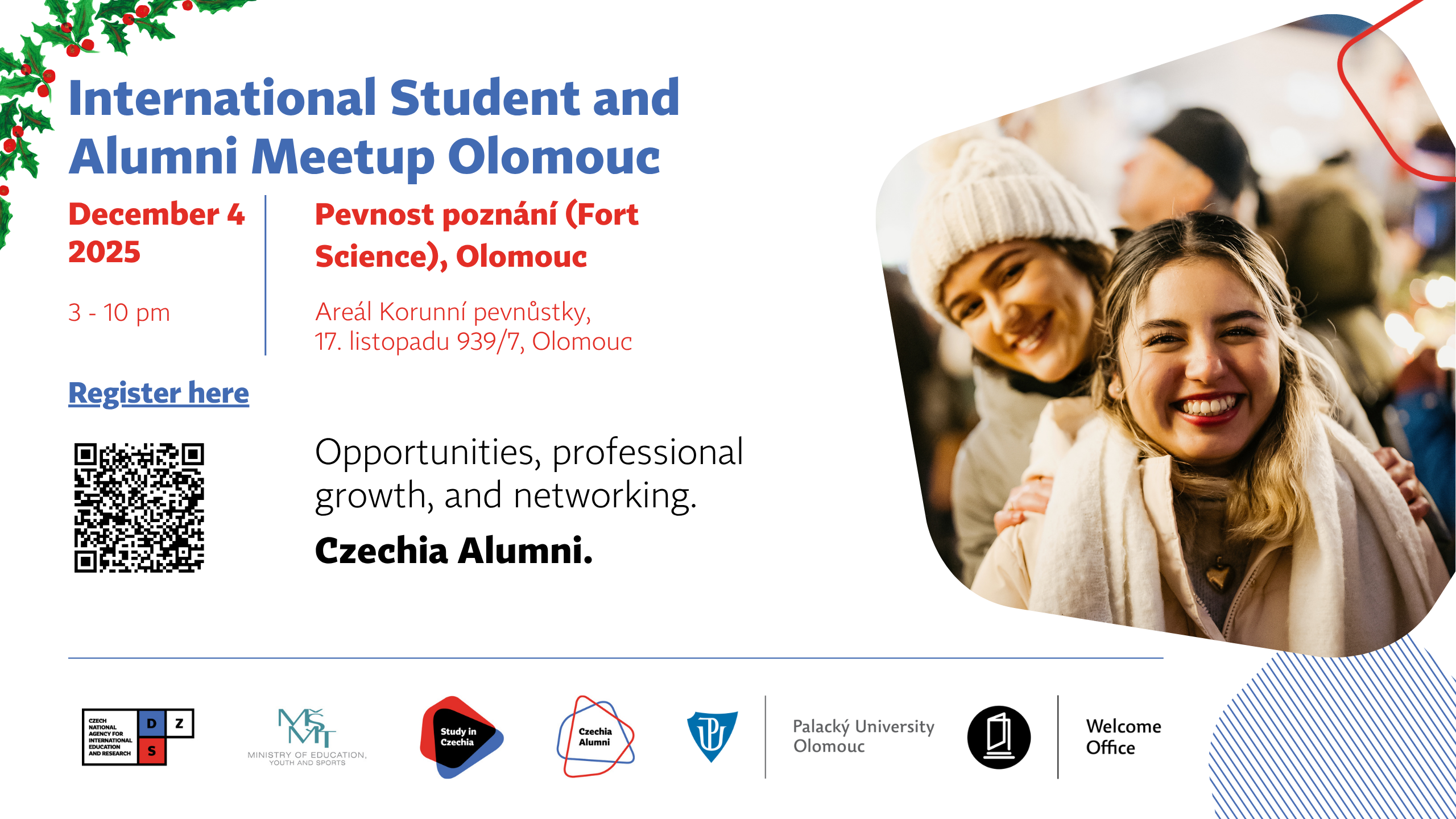
The International Student and Alumni Meetup Olomouc 2025 is just around the corner! Join us on 4 December 2025 at Pevnost poznání (Fort Science), Olomouc, for an inspiring evening full of networking, career workshops, a fair, and live music.
This is your chance to connect with fellow students and alumni from across Czechia in a friendly and dynamic setting.
This is your chance to connect with fellow alumni and students in a dynamic setting.
✔️ Get your free ticket: https://bit.ly/46FTFRJ
✔️ Invite your friends through Facebook or LinkedIn
✔️ Enjoy making new connections!
Don’t miss out – secure your spot today!